Water Soluble Products vs Traditional Cleaning Products
Most comparisons between water soluble and traditional cleaning products stop at packaging, as if switching only changes what ends up in the recycling bin. That misses most of what changes on the ground: how accurately a solution gets mixed, how much of it a member of staff handles by hand, how much storage space it takes up and what it costs per clean once shipping and waste are factored in. Those are the differences that show up in a facilities budget and a COSHH assessment, not just a sustainability report and they all trace back to one simple change in how water soluble cleaning products are actually put together.
How do water soluble cleaning products work compared to traditional ones?
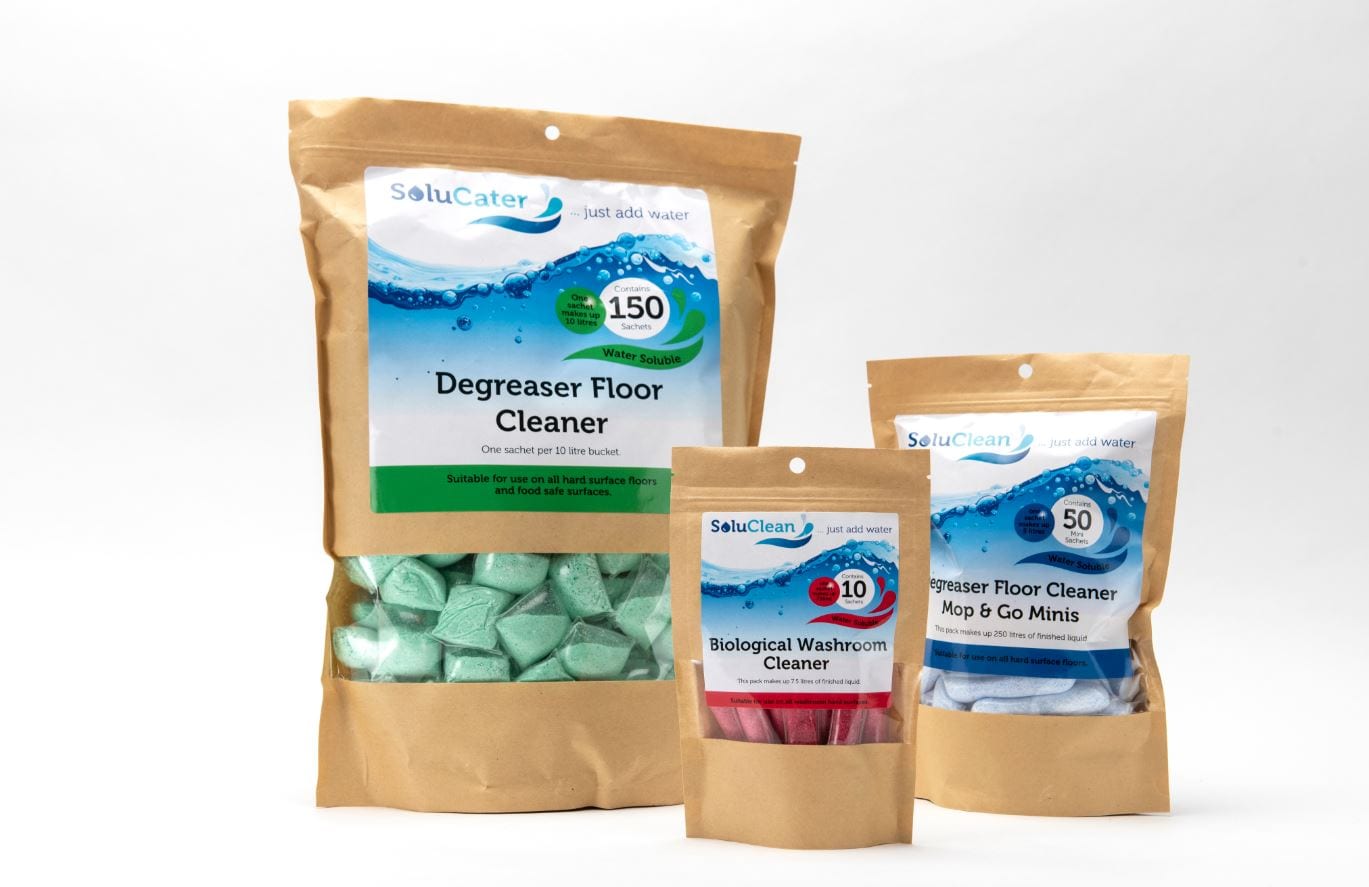
A traditional cleaning product is sold as a liquid, which means water is already part of what’s being shipped, stored and paid for before it ever reaches a mop bucket. Water soluble technology takes a different approach by removing water from the chemical formula itself and packing the concentrated cleaning agent into a sachet or pod made from film.
The film dissolves the moment it meets water, releasing a pre-measured dose directly into a reusable spray bottle or bucket, and leaving only minimal residue behind once it’s dissolved. The material behind that dissolving effect is water soluble PVA film, a material made specifically to break down completely the moment it touches water.
Do water soluble cleaning products have as long a shelf life as traditional ones?
This is a fair question for anyone used to rotating stock before it expires. Most commercial cleaning concentrates carry a shelf life of around one to two years once manufactured, after which the active ingredients can start to degrade, separate or lose potency, particularly if they’ve been stored somewhere with fluctuating temperature. Solupak’s sachets are rated for a three year shelf life when kept dry, which holds up longer than most traditional liquid concentrates manage even under ideal storage conditions.
That longer shelf life changes how a business can buy. There’s less pressure to use up stock before it degrades, less risk of a half-used bottle being thrown away because nobody’s sure how long it’s been open and more flexibility to order a larger batch without worrying about waste further down the line.

How much more accurate is dosing with water soluble sachets?
Cleaning product dilution accuracy is one of the more overlooked differences between the two systems. A traditional concentrate relies on a member of staff measuring correctly against a cap line or a dosing pump being calibrated properly and both are prone to drift over time, whether that’s a slightly overfilled cap or a pump that’s fallen out of calibration without anyone noticing. Consistent dosing with a water soluble sachet removes that variable entirely, since the sachet contains a fixed, pre-measured amount every single time, regardless of who’s making up the solution or how many times it’s been done that day.
This matters beyond just getting the mix right. Overdosing wastes product and puts more chemical onto whatever’s being cleaned than it needs, while underdosing means the solution doesn’t perform as intended, which in a healthcare or catering setting isn’t just a performance issue, it’s a compliance one.
Do water soluble products save storage space and reduce cost per use?
Cleaning product storage space adds up faster than most facilities managers expect once you account for a full range of products across degreasers, sanitisers, disinfectants and general surface cleaners. Bulky bottles and drums of ready-to-use or lightly diluted liquid take up considerably more shelf and cupboard space than the same number of doses packed as concentrated sachets, since a large part of what’s being stored in a bottle is water that hasn’t been added yet.
Cost per use of cleaning products comparisons tend to favour the concentrated sachet format for a similar reason. Shipping and storing water costs money whether it’s doing any cleaning or not and a lighter, more compact product reduces both transport costs and the space needed to hold enough stock for a busy site. Businesses looking to reduce cleaning product waste across a facility often find the sachet format naturally supports that goal, simply because there’s no leftover half-used bottle sitting at the back of a cupboard.

Are water soluble cleaning products safer for staff to handle?
Chemical exposure and cleaning staff safety is governed in the UK by COSHH, the Control of Substances Hazardous to Health Regulations, which require employers to control exposure to hazardous substances including everyday cleaning chemicals. A traditional concentrate is typically poured or measured out by hand, which creates a direct point of contact with a substance that’s often corrosive or irritant in its undiluted form. A sealed sachet removes that step. The concentrate stays fully contained until the sachet dissolves in water, meaning cleaning staff chemical handling safety improves simply because there’s no pouring, splashing or measuring involved at any point.
Its important to follow your organisation’s COSHH guidelines, though no PPE needs to be worn and there are no manual handling risks.
This format also supports BICSc colour coding, the British Institute of Cleaning Science’s system for preventing cross-contamination between different areas of a facility. Solupak’s sachets dissolve and colour the water in the trigger bottle being prepared, making it immediately obvious which solution belongs in which coloured bottle and reducing the risk of the wrong product ending up in the wrong area.
Do water soluble cleaning products perform as well as traditional cleaners?
Do water soluble cleaning sachets work as well as traditional cleaners is a fair question, since a format change doesn’t count for much if the resulting solution doesn’t clean properly. The ingredients inside a water soluble sachet are the same kind of chemistry used in traditional formulations, just concentrated rather than diluted, so performance comes down to the formula rather than the packaging format itself.
A concrete example is worth more than a general claim here. Solupak’s anti-viral cleaner kills 99.999% of viruses in testing, delivered in exactly this sachet format, which demonstrates that moving to a pre-dosed system doesn’t mean compromising on the standard a product needs to meet in a demanding environment like healthcare or catering. The short version is that removing water from the formula dramatically reduces the packaging required compared to traditional single-use liquid solutions, cutting down on the plastic that would otherwise need transporting, storing and disposing of, is part of what makes water soluble products a sustainable commercial cleaning solution and an eco responsible choice.

Why are businesses across different sectors switching to Solupak?
The same pre-dosed format solves a different problem in each sector, which is part of why it’s spread so widely rather than sticking to one niche:
• Water soluble cleaning products for catering settings need to hold up against grease, high turnover and strict hygiene inspection, which is why Solupak’s catering range includes degreasers, surface sanitisers and disinfectants built specifically for that kind of pressure.
• Commercial cleaning sachets for offices and water soluble cleaning products for schools lean on the same Soluclean Daily Cleaning range, tested against coronavirus and suited to environments where non-specialist staff are often doing the cleaning
• Pre-dosed cleaning products for facilities management teams covering multiple sites benefit from consistency above almost anything else, since the same sachet produces the same result whether it’s used in one building or fifty
• Healthcare, dental and optical settings rely on pre-dosed chemicals that dissolve quickly and perform reliably in fast-paced clinical environments
• Medical device manufacturing uses Solupak’s enzymatic detergents, developed specifically to meet exacting cleaning standards in that sector
That range of sectors is covered in full on Solupak’s industry sectors page, including how the format adapts to each one’s specific requirements.
Water soluble vs traditional cleaning products at a glance
| What Matters | Traditional Liquid Concentrate | Water Soluble Sachet |
| Dosing accuracy | Depends on staff measuring correctly, or a pump staying calibrated | Fixed, pre-measured dose every time |
| Staff Chemical Contact | Direct contact when pouring or measuring | Sealed until the sachet dissolves in water |
| Storage Space | Bulky bottles and drums, mostly water | Compact and lightweight, minimal shelf space |
| Shelf Life | Around 1 to 2 years before ingredients degrade. | Around 3 years when kept dry |
| Cost Per Use | Higher once shipping and storing water is factored in | Lower, since no water is shipped or stored |
| Formats Available | Ready to use liquid, or concentrate with a dosing pump | Sachets and pods in cold water or hot water soluble film |
What’s the difference between water soluble and traditional cleaning products ultimately comes down to is how much a business has to manage by hand versus how much the format handles on its own, whether that’s getting the mix right, keeping staff away from concentrated chemicals, or not paying to ship and store water. Treating that as an operational question rather than a packaging one is really what makes this comparison worth taking seriously.
Solupak has been developing water soluble manufacturing solutions since 1998, working with businesses across agriculture, catering, healthcare, facilities management and beyond to move away from traditional liquid formats without losing any performance along the way. Get in touch with our team today to talk through what a switch would look like for your business.



 English (UK)
  Français
  Español