Water Soluble Packaging vs Traditional Plastic Packaging
Most businesses using cleaning products have relied on traditional plastic packaging for so long it’s never really been questioned. Bottles, dispensers, tubs and trigger sprays have been the industry standard for decades and for most operations, that’s simply how things have always been done. But with plastic regulations tightening, sustainability targets becoming harder to ignore and better alternatives now well proven across the sector, that standard is worth a closer look.
Water soluble packaging has changed how cleaning products are packaged, transported, dosed and disposed of. This post compares both formats across the things that matter most to manufacturers, distributors and the businesses using these products every day.
The Difference Between Traditional Plastic and Water Soluble Packaging
Traditional plastic packaging for cleaning products is what most facilities managers and cleaning teams already know well. Multi-litre bottles of concentrated or ready-to-use solution, wall-mounted dosing dispensers, trigger sprays filled from larger containers and rigid plastic tubs for powder-based products are all standard across the industry. What they all have in common is that the packaging is a permanent physical object. Once the contents are gone, the container remains and has to be dealt with.
Water soluble packaging works differently. The packaging is made from PVA film, a material that dissolves completely in water without leaving any harmful residue. In the cleaning sector, this film is used to make water soluble sachets packaging and water soluble pods packaging, each containing a pre-measured concentrated dose of product. When the sachet or pod meets water, the film and the product dissolve together. There’s no container to rinse, no cap to throw away and no single use plastic waste to manage. Once the pack is finished, the outer packaging that held the pods or sachets is fully recyclable. Our water soluble technology page explains how the system works and how it fits into day-to-day cleaning operations.
The Environmental Problems With Traditional Plastic Packaging
The environmental impact of traditional plastic packaging in the cleaning industry goes further than most people realise. Production depends on fossil fuels, is energy intensive and creates greenhouse gas emissions before the product has even left the factory. Most plastic cleaning containers are single use by design and despite recycling being widely available in the UK, actual recycling rates for plastic packaging remain well below what’s produced. A large proportion ends up in landfill or in the environment, where it can persist for hundreds of years.
There’s also the transport issue, which is easy to overlook. Ready-to-use cleaning products are predominantly water. Businesses are paying to manufacture, fill and ship large plastic containers that are mostly water, creating emissions across the entire supply chain unnecessarily. The UK Government’s Extended Producer Responsibility framework for packaging now places direct financial obligations on businesses based on the packaging they put on the market, which means this inefficiency carries a growing cost as well as an environmental one.
How PVA Film Differs From Conventional Plastic
PVOH film isn’t a greener version of conventional plastic. It’s a different class of material altogether. Traditional plastic polymers are derived from petrochemicals and resist biological breakdown for centuries. PVA dissolves in water and biodegrades without leaving toxic residues or contributing to microplastic pollution, which is one of the most significant environmental problems linked to conventional plastic today.
The production process for PVA film is also less resource intensive. It requires fewer fossil fuel inputs, produces fewer pollutants during manufacture and has a lower environmental footprint across its lifecycle. Our blog on whether water soluble film is eco-responsible looks at this in more detail for anyone wanting to understand the material science behind sustainable packaging solutions.
It’s worth addressing the biodegradable packaging question here too, because there’s a lot of confusion around it. Many plastic products marketed as biodegradable require specific industrial composting conditions to break down, conditions that don’t exist in standard waste disposal. PVOH doesn’t have those limitations and the way water soluble materials have developed over the years helps explain why it sits in a different category altogether from conventional biodegradable plastic claims.
How Water Soluble Packaging Reduces Transport Costs and Carbon Footprint
With traditional ready-to-use cleaning products, the majority of what’s being transported is water. A five-litre bottle of surface cleaner contains a small percentage of active cleaning ingredients, with the rest being water added during manufacturing. Across a full pallet, that’s hundreds of kilograms of water moving through the supply chain, at cost and with associated emissions at every stage.
Water soluble sachets contain concentrated product only. The water is added by the end user at the point of use, so only the active ingredients are manufactured, packaged and shipped. The difference in volume and weight is substantial and for businesses managing cleaning supply across multiple sites, the savings on both cost and carbon footprint are meaningful and measurable:
• A full pallet of five-litre liquid concentrate can be replaced by just a few packets of concentrated sachets
• Fewer deliveries are needed to supply the same number of cleaning operations
• Storage requirements are significantly reduced at both distributor and end user level
• Transport emissions per unit of cleaning product delivered are considerably lower
For businesses managing cleaning supply across multiple sites, those efficiencies have a direct and measurable impact on both operational costs and carbon footprint.
Pre-Measured Dosing vs Pouring From a Bottle
Dosing consistency is one of the clearest practical differences between the two formats. With traditional plastic bottles and dispensers, the person using the product has to measure the correct amount themselves. In practice, over-pouring is common. It wastes product, increases the chemical concentration in the solution and can result in a mixture that’s either too weak to clean or disinfect properly, or too strong, which risks damaging surfaces and increasing chemical exposure for whoever’s using it.
Water soluble pods and sachets remove that variable entirely. Each unit contains a pre-measured dose of concentrated product, calibrated for a specific dilution in a specific volume of water. When the pod or sachet is dropped in, it releases the formula at exactly the right concentration. There’s no measuring, no guesswork and no variation between one person and the next. The solution is correct every time, which in regulated commercial cleaning environments where hygiene standards are audited, makes a real operational difference.
How Water Soluble Packaging Supports Better Hygiene and Cleaning Standards
The format of this primary packaging has a direct effect on hygiene standards, and water soluble pods and sachets have clear advantages over traditional plastic in this area. Each pod or sachet keeps the cleaning product contained and uncontaminated until the moment it’s used at the point of application. There’s no open container being repeatedly handled during storage, no spillage risk during pouring and minimal leftover plastic product sitting in a part-empty bottle between uses.
The format also supports BICSc colour coding compliance, which is the British Institute of Cleaning Science’s system for preventing cross-contamination between different areas of a facility. Solupak’s water soluble sachets are designed to align with this system. The dissolving sachet colours the water in the trigger spray bottle being prepared, making it immediately clear which solution is for which area and reducing the risk of cross-contamination in the process. Our article on how water soluble technology transforms cleaning in the catering industry is a good example of what this looks like in one of the most hygiene-critical environments there is.
What Tightening Plastic Packaging Regulations Mean for Businesses
The regulatory environment around plastic packaging in the UK is moving in one direction. The Plastic Packaging Tax applies to plastic packaging manufactured in or imported into the UK that contains less than 30% recycled content, adding a direct cost to businesses still using conventional plastic formats. Extended Producer Responsibility adds further financial obligations based on the type and volume of packaging placed on the market each year.
These aren’t future concerns. They’re active pressures that businesses in the cleaning products sector are already dealing with. Switching to water soluble pods and sachets means the primary packaging is designed to work directly in water at the point of use rather than becoming single-use plastic waste, while the outer packaging is fully recyclable. That significantly reduces the volume of single-use plastic being placed on the market, meaning lower fee liability and far less exposure to charges that are only going to increase as the regulatory framework develops.
How Solupak Approaches Water Soluble Packaging Manufacturing
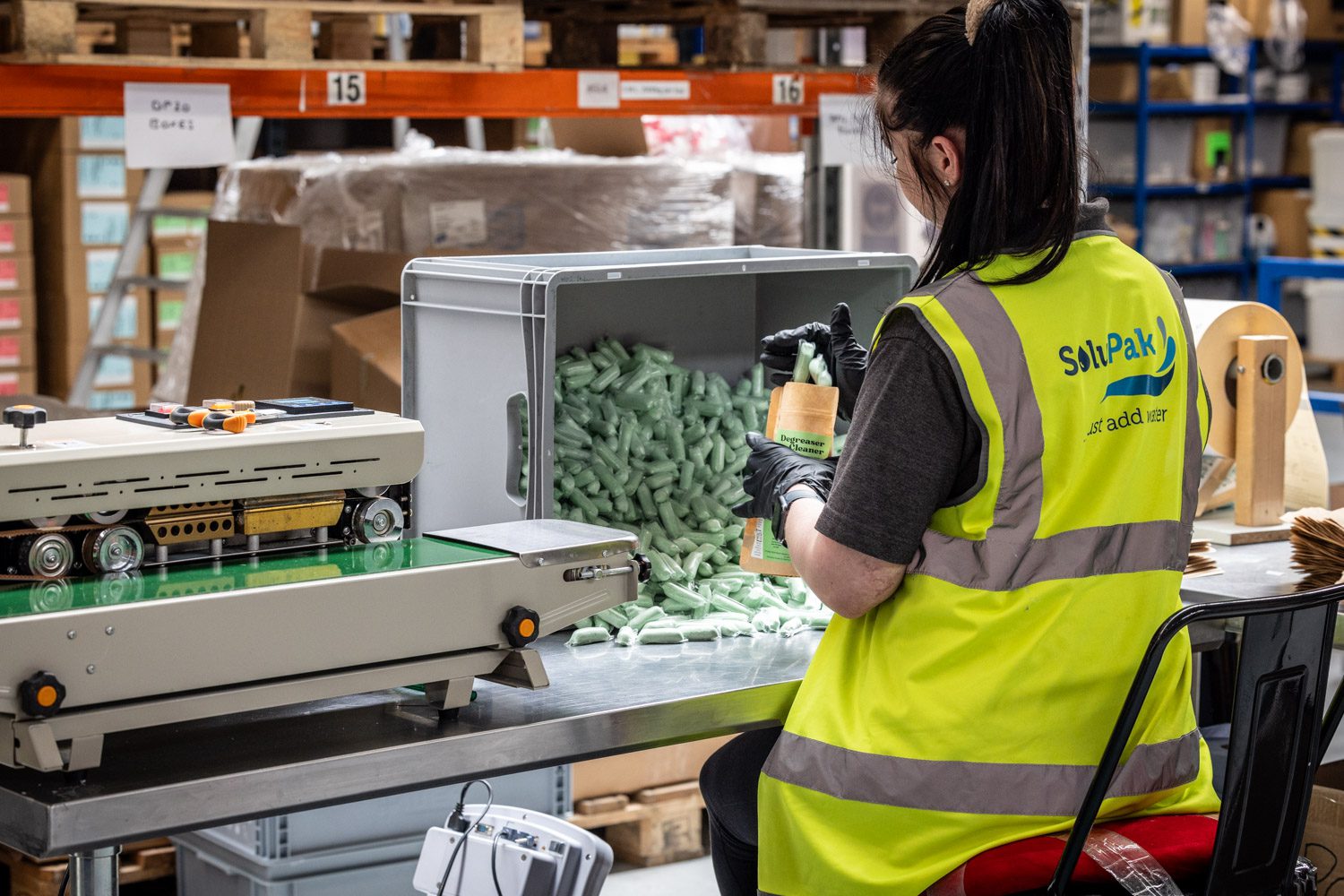
Solupak has been manufacturing water soluble sachets and water soluble pods from our Yorkshire facility since 1998 and everything from concept and R&D through to packaging and distribution is handled in-house. That end-to-end approach is what allows us to maintain the quality and environmental standards we hold ourselves to across every project we take on.
Our accreditations to ISO 9001, ISO 14001 and ISO 45001, alongside Cruelty Free International and Ecolabel certifications where applicable, reflect the standards the business has been built around. That commitment runs through everything we do, from the materials we use to the way we work with the businesses we supply.
On every measure that matters, water soluble pods and sachets outperform traditional plastic as a primary packaging solution for cleaning products. The material is safer, the format is more efficient, dosing is more consistent, the transport footprint is dramatically lower and the plastic reduction is concrete and quantifiable. As regulations tighten and sustainability expectations grow across the supply chain, the case for sustainable packaging solutions like water soluble sachets packaging and water soluble pods packaging only strengthens.
If you’d like to find out how Solupak’s dissolvable packaging solutions could work for your business, or you’d like to request a sample, get in touch with our team today. We’ll walk you through what the switch looks like and what it can deliver for your operation.



 English (UK)
  Français
  Español